
Most lawn care owners start by copying what the guy down the street charges. That works until you notice some lawns take twice as long for the same money. Here is a simple way to price mowing so every stop on your route pays.
Start with what an hour costs you
Before you price a single lawn, know your cost per crew hour. Add up a normal month:
- Wages and payroll taxes for the crew
- Fuel, truck payment and insurance
- Equipment payments, blades, oil and repairs
- Phone, software, marketing and dump fees
Divide that by the hours your crew actually mows in a month (not the hours they are on the clock). If a two-person crew costs you $70 an hour and you want a healthy margin, your target might be $100 to $120 per crew hour.
Turn time into a price per lawn
Now time a few lawns of different sizes, from the moment the truck parks to the moment it leaves. Include trimming, edging and blowing. You will find something like this:
- Small lot (under 5,000 sq ft of turf): 20 to 25 minutes
- Medium lot (5,000 to 10,000 sq ft): 30 to 40 minutes
- Large lot (10,000 to 20,000 sq ft): 45 to 70 minutes
Multiply by your target hourly rate and you have a price that covers your costs, not a guess.
Per visit, per square foot or per hour?
Per visit is what homeowners understand. Quote one number for a normal cut.
Per square foot is how you get to that number fairly. Many crews use a base price plus a price per 1,000 square feet of turf. Example: $35 base plus $4 per 1,000 sq ft above the first 3,000.
Per hour works for cleanups and odd jobs, not for weekly mowing. Customers do not like an open meter.
The best setup is usually a per visit price built from square footage. The customer sees one number, and you know it is right.
Charge for what slows you down
These add time and should add money:
- Steep slopes, ditches and lots of obstacles (trampolines, beds, play sets)
- Overgrown first cuts (charge a one-time first visit fee)
- Bagging and haul-away
- Gates you have to open and close, dogs you have to wait for
- Edging hardscape every visit instead of every other visit
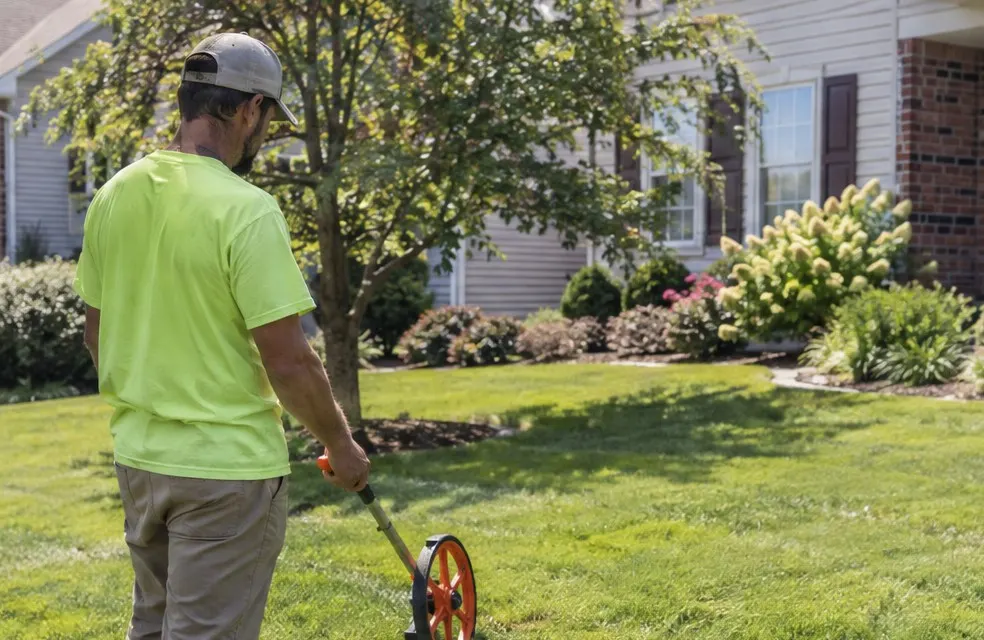
Measure before you drive out
Driving out to measure a lawn for a $45 job eats your profit. Use a satellite map to outline the turf and get the square footage from your truck. A calculator on your website can do this for the customer too: they trace their yard and see your price range before they call. The people who reach out already accepted the number.
Raise prices once a year
Fuel, insurance and wages go up every year. Send a short note every winter with the new season price. Most customers expect it, and the ones who leave over a few dollars were usually your least profitable stops.
The short version
Know your cost per hour, time real lawns, price per visit from square footage, and charge for anything that slows you down. Then let your website show the price so you stop driving to estimates that never close.
Frequently asked questions
What is a fair price to mow an average lawn?
In many US markets a standard suburban lawn runs $35 to $65 per visit. Your price should come from your own cost per crew hour and the time the lawn takes.
Should I charge more for the first cut?
Yes. An overgrown first cut can take twice as long. A one-time first visit fee is normal and customers accept it when you explain it up front.